Technique & Skill
There are two kinds of cooking knowledge. There's the kind you can read — ratios, temperatures, the science of emulsification. And there's the kind that lives in your hands.
The feel of properly developed dough. The sound of a correct sear. The instinct for when a sauce is thirty seconds from breaking.
The second kind only comes from repetition, and it's what separates cooks who are capable from cooks who are good. These videos are worth watching more than once. A great demonstration of knife work isn't educational the first time — it's educational the twentieth time, when you've done the cut yourself a hundred times and can finally see the specific thing you're still getting wrong.
Why Watching Isn't the Same as Learning
A skilled cook makes everything look easy, and that's the trap. The knife glides through the onion because a thousand hours of practice found the exact grip, angle, and motion that eliminates resistance. The sauce comes together in seconds because the cook knows instinctively when the temperature is right and how much fat to add.
None of it was natural. All of it was built through deliberate practice, usually with someone standing next to them correcting their wrist angle or their pan technique. Video can't correct your wrist.
But it can show you what correct looks like, clearly and repeatedly, so that when you practice, you know what you're aiming for. Watch carefully. Practice slowly.
Watch again and find what you missed.
Why Watching Isn't the Same as Learning
A skilled cook makes everything look easy, and that's the trap. The knife glides through the onion because a thousand hours of practice found the exact grip, angle, and motion that eliminates resistance. The sauce comes together in seconds because the cook knows instinctively when the temperature is right and how much fat to add.
None of it was natural. All of it was built through deliberate practice, usually with someone standing next to them correcting their wrist angle or their pan technique. Video can't correct your wrist.
But it can show you what correct looks like, clearly and repeatedly, so that when you practice, you know what you're aiming for. Watch carefully. Practice slowly.
Watch again and find what you missed.
“A great demonstration isn't educational the first time. It's educational the twentieth.”
The Foundations Worth Practicing
416 videosVideos on knife skills, cooking fundamentals, plating techniques, and the craft behind professional cooking at every level.
4 videos tagged “Bon Appetit”

How One of NYC’s Best Chefs Makes Salmon (3 Michelin Star) | Made to Order | Bon Appétit
Eric Ripert handles salmon like he's performing surgery — every cut deliberate, every motion economy in service of the fish. Watch him work the knife and you'll see thirty years of muscle memory that can't be taught from a YouTube tutorial, only earned through ten thousand services where perfection was the baseline, not the goal. The man treats a piece of fish with more reverence than most people reserve for Sunday mass. This is what mastery looks like when the cameras happen to be rolling.

Inside 20 Chefs' Knife Rolls: Pro Chefs Reveal Their Go-To Tools | Restaurant Talks | Bon Appétit
Twenty knife rolls opened like prayer books, each one a meditation on what matters when the tickets start flying. You'll see the expected — Global gyutos, Wüsthofs worn smooth, that one Kramer everyone pretends not to covet — but watch for the oddball tools that separate the posers from the professionals. The tweezers, the offset spatulas with electrical tape grips, the thermometer held together with a rubber band because it reads two degrees truer than anything else they've found. These aren't collections; they're survival kits built over years of service, each tool earning its place one shift at a time.
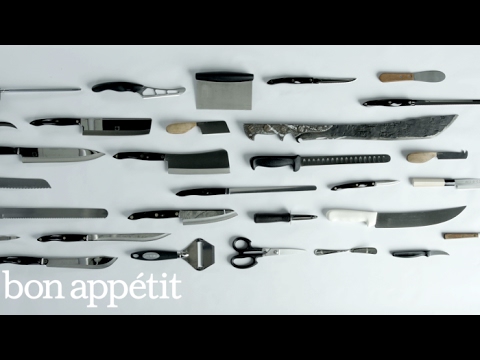
25 Knives, 47 Knife Skills | Bon Appetit
You can tell everything about a cook by watching their knife work for thirty seconds — the grip, the rhythm, how they move steel through an onion. This chef runs through 25 blades like a craftsman explaining his toolbox, each cut deliberate and earned through years of repetition. The difference between someone who owns knives and someone who actually uses them every day.

Professional Chefs Compete in a Knife Skills Speed Challenge | Test Kitchen Talks | Bon Appétit
Seven cooks with decent knife skills and a timer — you already know how this ends. The real show isn't who finishes first, it's watching hands that have logged serious hours on the line move with that automatic precision you can't fake. Notice how the fast ones aren't rushing at all, just letting muscle memory do what ten thousand brunoise have trained it to do. Everyone else is thinking about their fingers.
A cook who can break down a case of onions in ten minutes has twenty more minutes for everything else on the prep list. After the knife: heat management. Reading a pan.
Knowing the difference between a sear and a steam. Understanding what oil temperature actually sounds like. Then plating — not as decoration, but as the final step in communicating what the dish is supposed to be.
Each skill builds on the one before it, and none of them have shortcuts.
Technique and equipment are inseparable — understanding your tools is part of executing properly. Equipment & Tools goes deeper on the gear. For the business context that makes these skills valuable, Cost Control and Menu Design show how craft translates into a menu that works financially.